Lovell Carbon Reduction Plan
Carbon Reduction Plan
Supplier name:
Lovell Partnerships LTD (a division of Morgan Sindall Group)
Publication date:
24 April 2026
Commitment to achieving Net Zero
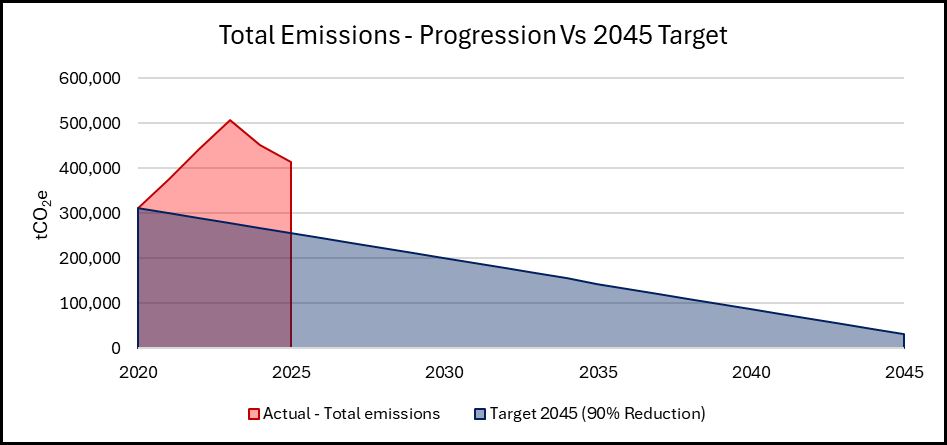
Lovell Partnerships Ltd (Lovell) is fully committed to achieving Net Zero greenhouse gas emissions by 2045 across all operational activities and throughout its value chain. The company has set a science‑aligned target to deliver a 90% absolute reduction in Scope 1, Scope 2, and Scope 3 emissions by 2045, measured against a 2019 baseline. Any residual emissions representing no more than 10% of the baseline, will be neutralised through verified carbon removal solutions as part of the Morgan Sindall Group carbon reduction plan.
Baseline Emissions Footprint
Baseline emissions are a record of the greenhouse gases that have been produced in the past and were produced prior to the introduction of any strategies to reduce emissions. Baseline emissions are the reference point against which emissions reduction can be measured.
Baseline Years: 2019 & 2020 | |
Additional Details relating to the Baseline Emissions calculations. | |
Our baseline emissions have been established using the earliest complete and consistent datasets available for the reporting boundary. Scope 1, Scope 2 and Scope 3 (Phase 1) emissions are reported against a 2019 baseline year. Scope 3 (Phase 2) emissions are reported against a 2020 baseline year; the 2020 Scope 3 (Phase 2) baseline was recalculated in 2025 to align with our third-party audited methodology and, as a result, the baseline emissions value changed. This recalculation did not change our Scope 3 (Phase 2) target. | |
Baseline year emissions: | |
EMISSIONS | TOTAL (tCO2e) |
Scope 1 | 1,934 |
Scope 2 | 738 |
Scope 3 (Phase 1)* | 1,604 |
Scope 3 (Phase 2)* | 307,948 |
Total Emissions | 312,224 |
*Please see Appendix Table 1 for a breakdown of Scope 3 categories and separation between Phase 1 and Phase 2.
Current Emissions Reporting
Reporting Year: 2025 | |
EMISSIONS | TOTAL (tCO2e) |
Scope 1 | 837 |
Scope 2 | 1,149 |
Scope 3 (Phase 1) | 871 |
Scope 3 (Phase 2) | 411,027 |
Total Emissions | 413,884 |
Emissions reduction targets
Our existing emissions reduction targets are set out below and are measured against the stated baseline years.
Emissions source | Baseline year | Target by 2030 | Target by 2045 |
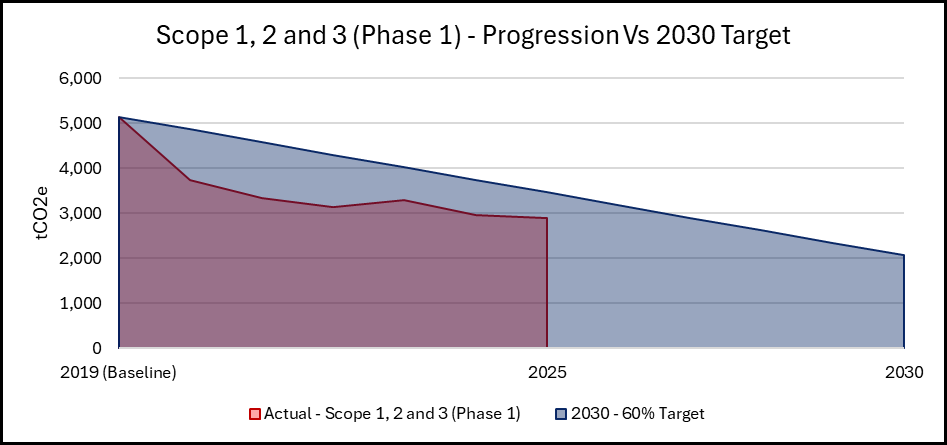
Scope 1 & 2 | 2019 | 60% reduction | 90% reduction |
Scope 3 (Phase 1) | 2019 | 60% reduction | 90% reduction |
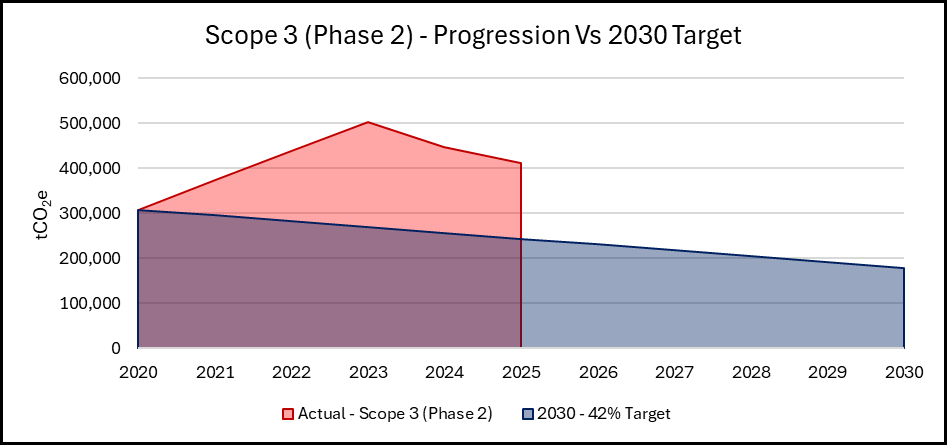
Scope 3 (Phase 2) | 2020 | 42% reduction | 60% reduction |
Progress against these targets can be seen in the graph below:
Progress against these targets can be seen in the graphs below:
Carbon reduction projects
Completed carbon reduction initiatives
Bulk Fuel Transition
Bulk fuel use has historically been a major contributor to our operational emissions. Since the 2019 baseline, we have undertaken a significant transition away from traditional diesel to Hydrotreated Vegetable Oil (HVO). As of 2025, 99.99% of all bulk fuel we ordered for delivery to our sites is HVO.
In 2019, Lovell consumed 923,862 litres of bulk fuel, generating 2,548 tCO₂e.
In 2025, despite an increase in activity and consumption to over 1,100,000 litres, emissions fell dramatically to 49 tCO₂e. This represents a 98% reduction in carbon emissions, demonstrating the substantial savings achieved through the adoption of HVO and the impact of switching to lower carbon fuels at scale.
Company Car Fleet Electrification
Transitioning our company car fleet to electric or hybrid vehicles has delivered another major reduction in operational emissions. The shift has not only reduced carbon output but has also increased employee familiarity and confidence with EV technology.
In 2019, company car travel totalled 259,202 miles, producing 74 tCO₂e. By 2025, mileage had increased significantly to 1,656,803 miles, yet emissions reduced to 39 tCO₂e. This equates to a 47% reduction in emissions, despite a six fold increase in mileage a clear demonstration of the carbon benefits achieved. Lovell aim to build upon on this achievement by the transitioning to a full EV company car range in the future.
Future Carbon Reduction Initiatives
We will implement additional carbon‑reduction measures across our operations and value chain, including fleet decarbonisation, renewable energy generation, enhanced energy management systems, and deeper supply‑chain engagement.
Over recent years, we have taken meaningful steps to reduce the environmental impact of our company owned vehicles. Our corporate car scheme has already transitioned to a fully EV or a hybrid offering, and we have introduced incentives that encourage employees to choose electric or hybrid options for their private vehicles. These changes have helped build internal familiarity with low emission technologies and have strengthened the foundations for exploring further opportunities across our wider fleet. We plan to begin by trialling the replacement of selected commercial vans with electric or hybrid alternatives, supported by route and duty cycle assessments and suitable charging arrangements. The findings from this trial including operational performance will inform any future decisions on whether and how a broader roll out across the entire fleet may proceed.
Lovell will look for further opportunities to install additional onsite solar PV arrays and explore other renewable solutions across our regional offices and construction sites. This will help us increase the share of electricity generated from renewable sources over time and reduce our reliance on grid electricity where feasible.
Alongside this, we are undertaking ongoing trials of energy management systems across several of our sites. These trials are designed to help us better understand and reduce electricity consumption, optimise usage patterns, and identify areas where demand is likely to increase as our operations continue to grow. Insights from these trials will support more efficient energy use, strengthen our approach to monitoring and reduction, and ensure we are proactively addressing future consumption hotspots.
Purchased materials and services are our highest source of emissions, accounting for 63% of our total footprint. Because of this, Lovell is setting internal targets and clear supply chain expectations to establish the framework against which we will hold ourselves accountable. A key focus will be collaborating closely with suppliers to ensure the products and services we procure carry a lower carbon impact. Strengthening the quality of supply chain emissions data will also enhance our datasets and support better informed decision making across the business.
Declaration and Sign Off
This Carbon Reduction Plan has been completed in accordance with PPN 06/21 and associated guidance and reporting standard for Carbon Reduction Plans.
Emissions have been reported and recorded in accordance with the published reporting standard for Carbon Reduction Plans and the GHG Reporting Protocol corporate standard and uses the appropriate Government emission conversion factors for greenhouse gas company reporting .
Scope 1 and Scope 2 emissions have been reported in accordance with SECR requirements, and the required subset of Scope 3 emissions have been reported in accordance with the published reporting standard for Carbon Reduction Plans and the Corporate Value Chain (Scope 3) Standard . All our figures for emissions have been audited by Achilles Information Limited.
This Carbon Reduction Plan has been reviewed and signed off by the board of directors (or equivalent management body).
Signed by Rob Worboys - Head of Procurement and Sustainability
24 April 2026
[1]https://ghgprotocol.org/corporate-standard
[2]https://www.gov.uk/government/collections/government-conversion-factors-for-company-reporting
[3]https://ghgprotocol.org/standards/scope-3-standard
Appendix 1 - Scope 3 Categories
Previously measured and reported Scope 3 categories are referred to in this report as “Phase 1”. Following improvements in data availability and analytical methods, all other applicable Scope 3 categories have now also been baselined and are included in reporting (with the exception of end‑of‑life treatment, as noted below). These newly incorporated categories are referred to in this report as “Phase 2”.
Scope 3 Category | Reference (Phase 1 or 2) |
1. Purchased goods and services | Phase 2 |
2. Capital goods | Not applicable |
3. Fuel and energy related activities not included in scope 1 and scope 2 | See split below |
3.1 Bulk fuel Well -to-tank (WTT) | Phase 2 |
3.2 Electricity Transmission of energy (T&D losses) | Phase 1 |
3.3 Electricity Well-to-tank (WTT) (Generation) | Phase 2 |
3.4 Electricity Well-to-tank (WTT) (T&D losses) | Phase 2 |
3.5 Gas Well-to-tank (WTT) | Phase 2 |
4. Upstream transportation and distribution | Phase 2 |
5. Waste generated in operations | See split below |
5.1 Waste generated in operations – Landfill | Phase 1 |
5.2 Waste generated in operations – Diverted from landfill | Phase 2 |
6. Business travel | Phase 1 |
7. Employee commuting | Phase 2 |
8. Upstream leased assets | Not applicable |
9. Downstream transportation and distribution | Not applicable |
10. Processing of sold products | Not applicable |
11. Use of sold products | Phase 2* |
12. End of life treatment of sold products | Not reported** |
13. Downstream leased assets | Not applicable |
14. Franchises | Not applicable |
15. Investments | Not applicable |
* Use‑of‑Sold‑Products emissions were calculated in line with RICS Whole Life Carbon Assessment guidance, using SAP‑derived in‑use energy data across the full assumed building lifespan.
** Currently, limited information on end‑of‑life treatment prevents meaningful reporting against this category. We plan to complete this calculation in 2026.